Showing posts with label exhibition. Show all posts

Thursday, November 1, 2012

Van Gogh: Genius and Covetous?

Vincent Van Gogh: A man of many talents...and many mysteries.  Here’s a small list of ‘did you know...?’:

  • That he was a teacher?

  • That he was a missionary?

  • That he was a late-bloomer, artistically?  (He didn’t start painting until his late-twenties.)

  • That he was an extremely dedicated worker...he produced around 2,100 artworks in about ten years.  That works out to 210 sketches/paintings/watercolours/doodles per year!  (If you happen to be in possession of any of them, you’d be guaranteed to be an owner of a valuable piece of art!)

  • That he was named after his stillborn baby brother?

  • That he suffered from mental illness...leading up to the supposed self-inflicted shooting?

  • That after he shot himself, he was able to walk back to his hostel, and was left smoking a pipe by two physicians who told him they couldn’t remove the bullet?

  • That he survived for 29 hours after he was shot?

  • That there is a theory that somebody else shot him, because the gun was never found?


And, for the purposes of this article:
That he was a ‘the grass is always greener...’ sort of guy.


Japonaiserie: Flowering Plum Tree (after Hiroshige), Paris, 1887. Can you tell it’s a copy?


The Courtesan (after Eisen), Paris, 1887.


Allow me to explain.  For me, it’s usually: ‘I wish I was taller.  Then I’d be able to wear those shorts, that dress, yadayadayada.” You know what I mean, everybody has something they wish was different, or wish they had.  Van Gogh, or Vinnie to his friends, was no different.  But for him, the green-eyed monster appeared through an unlikely source: that of Japanese ukiyo-e wood block prints.  About the time that he was in Paris, Vinnie discovered this form of Japanese art, and fell in lust.  He collected hundreds of these prints, but collecting wasn’t enough.  He wanted to own this form of artwork, and create it himself.  So, Vinnie did the equivalent of what I do to make myself taller. (No, he didn’t buy a new pair of ultra-high stilettos.) He copied existing Japanese wood-prints!  Now, some people might want to throw the word ‘plagiarism’ around, some may want to commend him on his source of inspiration.  Whatever, I’m not judging.  I will say, that Vinnie’s three notable works in the ‘Japonisme’ style are incredibly detailed, bold and masterfully executed.  Of course they are – it’s Van Gogh!


Portrait of Père Tanguy, Paris, 1887. Look how many copies of ukiyo-e he has painted!


However, finding out that one of the greats was as susceptible to a bit of peer-envy as I myself can be, well, I just find that selfishly reassuring.

But, please, don’t just take my word for it!  If you want to get up close and personal with Van Gogh and his work, and sneakily compare his take on Japanese ukiyo-e with the real deal, I strongly recommend that you make a trip to the Pinacothèque de Paris.  The dual exhibition of ‘Van Gogh et le Japonisme’ is on display from 03 October 2012 to 17 March 2013.  If Paris isn’t your scene – or you simply would rather wait until springtime (although Frank Sinatra does then go on to sing about how he loves Paris in every season), then you may be interested in looking up Vincent Van Gogh, written by Victoria Charles. 


Thursday, October 11, 2012

Women of the Pre-Raphaelite Movement: Models, Muses, Lovers, Artists

When you think of “Pre-Raphaelite”, what comes to mind? For me, it is male painters, female subjects, a lot of nature, and vivid colours. And for 95% percent of paintings produced by this movement, this is the reality.

The key members of the group (Hunt, Millais, the two Rossettis, Collinson, Stephens, and Woolner) were all men. Together, they created a secret group called the Pre-Raphaelite Brotherhood. Like just about every other artistic movement, the Brotherhood wanted reform. They rejected the academic styles of Raphael and artists after him, finding them idealised and corrupted. The Brotherhood sought a return to the Pre-Raphael Italian style with its vivid colours and imitation of nature.


Sir John Everett Millais, Ophelia, 1851-1852.
Oil on canvas, 76.2 cm × 111.8 cm.
Tate Britain, London.


The Pre-Raphaelites insisted on painting nature from direct observation to ensure it was depicted with accuracy and detail. Millais even stood outside for four months painting the background of one of the most well-known paintings of the movement, Ophelia (above). After he painted the landscape, he had the model for Ophelia lie in a full bathtub in his studio. But who was this model whose face is now so well-known? Her name was Elizabeth Siddal, and she eventually became a Pre-Raphaelite artist as well, which brings us to the exceptions to the 95% rule I mentioned earlier: the female artists who successfully joined the “brotherhood.”

Elizabeth Siddal was one of several model-turned-artists of the Pre-Raphaelite movement. She was a model for almost all of the members of the Brotherhood, and was the primary subject of Rossetti (who was said to have painted Siddal thousands of times). It’s no surprise that Rossetti and Siddal became lovers and eventually married. Rossetti taught Siddal to paint; she caught on quickly and developed her own unique style. Her self-portraits (see below) are interesting because one can compare how she perceived herself as opposed to how she was perceived by the artists she modelled for. Her other paintings (such as The Ladies’ Lament, below) are characteristic of the Pre-Raphaelite movement, with their focus on nature, vivid colours, and realistic subjects.


Elizabeth Siddal, Self Portrait, 1853-54
Oil on canvas, 22.9 cm circle.
Private collection.


Elizabeth Siddal, The Ladies' Lament, 1856.
Watercolour on paper, 241 x 229 mm.
Tate Britain, London.


Siddal was not the only female Pre-Raphaelite artist. Another notable woman from the movement was Rosa Brett, who was taught to paint by her brother, John Brett, and focused on painting landscapes.  In fact, there are at least twenty others. Several of them, including the celebrated Jane Burden Morris, were also models-turned-lovers-turned-artists like Siddal.

Although these 19th century women did not have access to their own formal art education, they found other ways to learn. Luckily for them, the Brotherhood was actually quite forward-thinking in their attitude towards female painters, who they welcomed into their circle. Despite the implied gender in the name, the Pre-Raphaelite Brotherhood was a movement that enabled women to pursue their passions and do more than just pose for paintings. Women were finally beginning to establish themselves in the artistic world.

If you are in London before January 13, 2013, make sure to check out the exhibition on the Pre-Raphaelites at the Tate Britain. You may be distracted by the amazing paintings by the Brotherhood, but keep your eye out for the 5%—the ones done by the women. If you can’t make it to the exhibition or just want to learn more about this movement, check out our ebook.

Thursday, October 4, 2012

Photoshopping and Photobombing...Peter Paul Rubens-Style!

When I open any magazine these days, I look at the photos of waif-like women with perfect skin, hair and teeth, without a jot of cellulite to be seen, and it’s what I expect to see.  I admit it!  The world of mass media has done its work very well indeed.  There is perhaps a handful of women who may be naturally blessed with the genetic make-up to look as flawless as those pictured on billboards without the help of Photoshop.   And that’s just it; technology such as Photoshop gives me expectations.  If I were to see an ad with the models remaining unaltered, I would be surprised.  It’s human nature.  To want to look better than we actually do, to make something or someone seem perfect and – with the right product or right clothing – to attract others to the same level of perfection.   And then it struck me, this is not a new concept.  When I look back at artists from the Renaissance and Baroque period, they do exactly the same thing.  (With paintbrush and easel instead of computer and mouse.)


Peter Paul Rubens, Portrait of Susanna Lunden (?) (‘Le Chapeau de Paille’), probably 1622-1625. Oil on wood, 79 x 54.6 cm. The National Gallery, London.


Take a look at some of Peter Paul Rubens’ work.  Although the curvier female form was highly admired and painted as it was – childbearing hips and all – Rubens still goes on to use the power invested in him as an artist to present the world with an interpretation of the model and the setting, rather than the real thing (or so I presume, having not been present at the actual time of painting.)  In the painting of Susanna Lunden, thought to be a marriage portrait, Rubens’ use of clear and stormy skies to create light and shadow is a way to illuminate the face and much of the upper torso.  In other words, she is glowing!  Now, if that isn’t a tactic to make someone look more presentable, I don’t know what is!


Perseus and Andromeda. Early 1620s, oil on canvas, 99.5 x 139 cm, The Hermitage, St. Petersburg.


During this thought process, my brain suddenly went into overdrive, and I began seeing links with modern culture everywhere in Rubens’ paintings.  One notable comparison that my oh-so-logical self came up with is the popular past-time of photobombing.  You know, you take a picture and when you look back at it, you notice that there’s an unusual face or activity happening in the background?  Well, I don’t know about you, but I see a big photobomb in Rubens’ Perseus and Andromeda.  My suspicions that Rubens had a sense of humour in his painting were confirmed by this painting.  At first glance it looks like a romantic, serious painting.  Okay, now look at the shield Perseus is carrying.  Look at the expression on Medusa’s face!  You heard it here first, Rubens was a photobomb master!  (Or should that be paintingbomb?)

If you happen to be in Germany before the end of February and would like to check out more of Rubens’ works, or simply make up your own mind whether he was a paintingbomb genius, head over to the Von der Heydt-Museum Wuppertal.  The Rubens exhibition will be held between the 16th October 2012 and the 28th February2013.  Alternatively, if going to Germany just isn’t possible right now, check out our book on Rubens written by Victoria Charles.

-Fiona Torsch

Tuesday, September 25, 2012

Impressionist, and proud

Underdogs have taken note and reclaimed terms that were once hurtful or derisory: ‘queer’ has become a positive label for the LGBT community, ‘nerd’ and ‘geek’ are no longer insults but badges of honour (thanks in part to the Gleeks), ‘slut walk’ participants have tried to de-stigmatise the word, and the Tea Party movement’s ‘tea-baggers’…well, that’s a bad example. But this ‘current’ propensity for linguistic reappropriation is not such a modern phenomenon…

The Impressionists came to be known as such after a 10-year battle for recognition. In 19th-century France, artistic esteem could only be attained by recognition by the Academy of Fine Arts and the displaying of their artwork in the Salons, or yearly exhibitions in Paris. This new art movement was too mind-blowing for those stuffy old codgers – Manet’s Luncheon on the Grass didn’t make the grade because of the daring inclusion of a stark-naked lady frolicking at a picnic. I can’t imagine what they would make of Prince Harry’s trip to Las Vegas…


Reconstruction of Prince Harry’s trip to Vegas…
Edouard Manet, Luncheon on the Grass, 1863.
Oil on canvas, 208 x 264.5 cm.
Musée d’Orsay, Paris.


A brief glimmer of hope came in 1863 when Napoleon III, shocked by the quality artwork that was being sidelined, opened an exhibition alongside the official Salon, an Exhibition for Rejects. This group of artists received more visitors than the official Salon, but most came along for a good chuckle at these deluded ‘artists’ and their strange paintings. Requests for another exhibition were denied, until in 1874 they decided to take matters into their own hands…

Thirty artists including Monet, Renoir, Pissarro, Sisley, Cézanne, Degas and Morisot participated in a private exhibition, which was still too zany for many. Louis Leroy wrote a sarcastic, satirical review, coining the term ‘Impressionists’ as a play on words of the title of Monet’s painting Impression, Sunrise. The term caught on, and what was meant to be a moniker of derision became a badge of honour for the group. And Leroy must have been laughing on the other side of his face when Impressionism spread beyond France, paving the way for Modern art, and even becoming the long-lasting legacy of 19th-century French art.

So take a leaf out of the Impressionists’ book and wear those insults with pride. My suggestions for some topically beleaguered individuals include: Prince Harry – ‘The Naked Prince’, Todd Akin – ‘The Legitimator’, and I’m sure Julian Assange could put a positive spin on ‘coward’, ‘tool’ or ‘cyber terrorist’.

Sweden’s Nationalmuseum has an exhibit dedicated to 19th-century France and the beginning of the Modern era, until 3 February 2013. If you would like to read more about the peppy Impressionists, try this impressive art book or compact gift version, written by Nathalia Brodskaya.


Thursday, September 20, 2012

In the Time of Devotion

What do you think of when someone mentions the Middle Ages? I’d say caves, toga-like clothing, candles, definitely a lot of candles, witches, the burning of said witches, and ceaseless devotion to God. Often, when the internet in my apartment isn’t working, I tell friends “I’m living in the Middle Ages” – which has more candles than devotion to God and witch burning.

Honestly, let’s face it, what else was there to do between the 5th and 15th centuries aside from worship God, be a witch or burn them, participate in the many crusades, and wait to meet your maker? If you think about it, maybe part of the reason life expectancy was so short is because it is actually possible to die of boredom*.

People talk about time machines and how incredible it would be to go back (or forward, for that matter) in time, but we’re living in the best time to be alive. We’ve got television and Batman; internet and Ryan Gosling. I wouldn’t have survived ten minutes in the Middle Ages, but would happily see how those that did, entertained themselves.


The Rheims Missal (Missale Remenense), The Creation of the World, 1285-1297.
Parchment, Latin, 23.3 x 16.2 cm.
Paris.


Bestiarum, Adam Naming the Animals, late 12th century.
Parchment, Latin, 20 x 14.5 cm.
England.


The Getty is at it again, exhibiting religiously charged images, starting this month through 3 February 2013 (assuming the world doesn’t end first and we meet the Powers that Be in person): The Art of Devotion in the Middle Ages. Often find yourself without internet or electricity, or do you simply want to go back in time? Procure this fantastic representation of manuscripts of the period: Illuminated Manuscripts by Edmond de Goncourt and Jp. A. Calosse.

*Research was still being conducted at time of posting.


-Le Lorrain Andrews

Monday, September 17, 2012

Restoration or Paint-by-numbers

I’m going to take this opportunity to get back on my high horse about the restoration and conservation of art for posterity’s sake. J. Paul Getty Museum, you’re doing it right!

Maerten van Heemskerck, a 16th century Netherlandish painter, bestowed Ecce Homo upon us, a masterpiece which usually resides in Warsaw, but has travelled all the way to Los Angeles – maybe not the first place I’d go after leaving Warsaw; however, definitely a site to see. A curatorial team and group of scientists have spruced it up, preserved it further, and learned more about it than has been known before. Not only has nothing but good come of this, but it is further ensured to stick around for many, many more years to come.

Two similar artists from this era also deserve equal honour and praise. Think of the many hours, days, months, even years Van Heemskerck, Hieronymus Bosch, and Hans Memling put into their notable and impressive altar pieces. Shouldn’t we, as a world-class, preservationist society make every effort to make sure our children, children’s children, and etc. are able to learn about these works of art and travel around the world to see them in their permanent homes? Personally, I’d be quite keen to see where Bosch created all of his glorious and damning images – though I’m sure that’s nearly impossible considering it was so very long ago and so little is known about his actual life.


Hieronymus Bosch, Terrestrial Paradise and Ascent of the Blessed to the Heavenly Paradise, after 1490.
Oil on panel, each panel: 86.5 x 39.5 cm.
Palazzo Ducale, Venice.


I would be devastated to learn that the beauty and wonder of the Paradise-like afterlife presented here had deteriorated beyond recognition, though I could deal with the authenticity of some fading. More so, I would be distraught at the loss of the pure and virginal women represented in Memling’s Annunciation (below). Forget Black Widow, this Halloween I’m dressing as the angel on the left – perhaps without the book of scripture.


Hans Memling, The Annunciation (exterior shutters of a triptych), 1472.
Oil on panel, shutters each 83.3 x 52.9 cm.
Groeningemuseum, Bruges.


However, is there such a thing as going too far? Do we reach a point of restoration in which the piece no longer projects any part of its original skin, so to speak, and is therefore no longer, the masterpiece it once was? Are we, ultimately, destroying art for art’s sake in an entirely different way, turning it into a paint-by-numbers?

Check out Ecce Homo in its newly restored glory at the J. Paul Getty Museum though 13 January 2013. Also see many more of Memling and Bosch’s masterpieces in these ebook and print editions: Hans Memling and Hieronymus Bosch.

-Le Lorrain Andrews

Tuesday, September 11, 2012

Caillebotte: Sugar Daddy of Impressionism

During his time, Gustave Caillebotte was known as a great supporter of the Impressionist movement. He had quite a bit of money due to a hefty allowance and inheritance from his father, which allowed him to purchase the works of his fellow Impressionists, subsidise several exhibitions, and even pay the rent for Monet’s studio. It wasn’t until after his death that Caillebotte was finally recognised as one of the great masters of Impressionism rather than simply a piggy bank for his friends. I suppose it’s typical for artists not to receive recognition and acclaim during their time, but it’s too bad that Caillebotte’s groundbreaking style, a mix between Realism and Impressionism, was clouded by his role as the Sugar Daddy of Impressionism.

Although classified as an Impressionist, Caillebotte’s style clearly differs from his counterparts such as Degas, Monet, Renoir, and Pissarro with whom he displayed his works at the second Impressionist exhibition in 1876. Many—myself included--consider him more of a Realist than an Impressionist. Due to Caillebotte’s passion for photography, his paintings often resemble photographs, capturing a single, fleeting moment in time quite realistically.


Gustave Caillebotte, Paris Street, Rainy Day, 1877.
Oil on canvas, 212 cm x 276 cm.
Art Institute of Chicago, Chicago.


Like his contemporaries, Caillebotte captured images of a rapidly changing Paris, the result of Napoleon III and Baron Georges-Eugene Haussmann's urban renewal project. Beautiful, tree-lined boulevards, green spaces and gardens, and modern public facilities arose, paving the way for the beautiful, dreamy Paris we all know today. However, unlike his fellow Impressionists, Caillebotte attempted to depict the new Paris in a more realistic way; his paintings often create a feeling of alienation and sorrow (Paris Street, Rainy Day, above). For him, the new metropolitan city, with its meticulously planned layout and design, was something like a SimCity—perfect from the outside, lonely from the inside.


Gustave Caillebotte, The Floor Scrapers, 1875.
Oil on canvas, 102 cm x 146.5 cm.
Musée D'Orsay, Paris.


Caillebotte is also known for introducing a new subject matter: the urban working class. As a result of the new railway and the Industrial Revolution in France (1815-1860), there was a huge migration of workers from the countryside to Paris. This new social class, la class ouvrière or the working class, became a fascination of Caillebotte’s. However, up to this point, the only portrayals of working-class life had been of peasants and farmers from the countryside. Hence, it came as no surprise that the Salon rejected The Floor Scrapers (above) in 1875, deeming it vulgar and offensive. They simply did not want to accept the reality—the sorrow, the poverty, and the brutal working conditions—of their new and improved Paris that Caillebotte so desperately wanted to portray through his work.


Want to see Caillebotte’s works and some outstanding photography from the late 19th and early 20th centuries? Head over to Schirn Kunsthalle Frankfurt between 18 October 2012 and 20 January 2013 for their exhibit Gustave Caillebotte. An Impressionist and Photography. You can also check out our ebook on Impressionism by Nathalia Brodskaya to learn more.


Follow us on Twitter and Pinterest

Like us on Facebook

Thursday, September 6, 2012

Ilya Repin: Stalin’s Golden Boy

Ukrainian-born Ilya Repin’s life spanned the turn of the 20th century, a particularly turbulent period in Russian history. A member of the Itinerants, he is one of the most celebrated social realist painters of all time, painting the lives of poor peasants and revolutionaries in exquisite detail, eschewing the burgeoning contemporary European impressionist movement. His paintings are a satirical commentary on the contemporary society of the Russian Empire, depicting scenes of peasantry (‘Barge Haulers on the Volga’), political and military scenes (‘Demonstration 17 October 1905’) and Cossack life (‘The Reply of the Zaporozhian Cossacks to Sultan Mahmoud IV’).

Soon after his death in 1930, Repin had developed into a cult figure. Revered by Stalin (supposedly his “favourite artist”*), his realistic portrayals of daily life inspired the ‘Socialist Realism’ of the new, centralised USSR. This genre depicted the suffering working classes as heroic in their struggles, which became heightened as the “elite” of the Stalinist regime were hypocritically bathing in the excesses that the position afforded them.

Stalin and Repin had similar beginnings, in that they were born into poorer families, in non-Russian soviet republics; the former being a Bolshevik revolutionary, whilst the latter was undoubtedly a sympathiser in the fight for social justice. However, somewhere along the way Stalin’s desire to escape the misery of his childhood lead to an abandonment of his roots, a skewing of his principles and a misappropriation of Repin’s work to champion his newly-held ideals.

Image
Ilya Repin, Leo Tolstoy as a Ploughman on a Field, 1887.
Oil on cardboard, 27.8 x 40.3 cm.
The State Tretyakov Gallery, Moscow


Why is it that there is so often a discrepancy between the austere measures a regime advocates for its citizens and the lavish lifestyle the officials themselves lead? From examples as tame as the privately educated millionaires that make up the current British government, and the ostentation of the Pope, to the more extreme cases of autocrats living the high-life whilst their citizens starve, this is evident the world over and repeated cyclically.

As power turns heads, it also turns minds. A love of art may become more sterile, as only ‘state-approved’ art get the seal of approval. Hitler approved of the Great Masters, where the spiritual morality and family values depicted could be manipulated to suit his own manifesto, as well as having art made to order by his favourite, compliant artists. Under most dictatorships, artistic intelligentsia are driven underground for fear of being purged, either for vocally dissenting from the regime, or due to the expectation that they would do so.

Image
Ilya Repin, Putting a Propagandist Under Arrest, 1880-1889.
Oil on canvas, 34.8 x 54.6 cm.
The State Tretyakov Gallery, Moscow.


Ironically, if Repin had been alive during Stalin’s reign of terror, it is reasonable to believe that he would have been painting scenes to satirise this monstrous hypocrite and his actions that, amongst other things, lead to around 7 million of Repin’s compatriots starving to death during the Ukrainian Famine of 1933. And had he lived on to lampoon, he would almost certainly no longer have been Stalin’s golden boy.

If you happen to be in Tokyo, check out the Bunkamura Museum where they are holding an exhibition (‘ILYA REPIN: Master Works from the State Tretyakov Gallery’, until Monday 8 October) featuring 80 Repin works on loan from the State Tretyakov Gallery. If Japan seems like a long way to go to see Repin’s works, why not try this Ilya Repin ebook instead, featuring many more masterpieces by this excellent realist painter.


* Rappeport, H. (1999). Art and Architecture. In: Joseph Stalin: A Biographical Companion. (p. 7). California: ABC-CLIO, Inc.


Tuesday, September 4, 2012

Paint the Sky with Van Gogh

On the over-arching subject of Symbolism, I’d have to say I am a fan. Beautiful colours and images which ultimately stand for something much deeper and more heartfelt than what is in front of you; colours and symbols which are meant to touch people around the world and bring them together using one piece of art. When it happens successfully, it’s truly amazing.

Take Vincent Van Gogh’s Starry Night (below), a piece recognised across time and place that enlists a quieting of the mind and moment of inner peace, which ultimately stirs in some of us a recognition of the fact that there may be more than just this life. However, some, namely Boy Meets World’s Cory Matthews, view this painting as an attack, a war over a small town. What do you see? More, how does it make you feel?


Vincent van Gogh, The Starry Night, 1889.
Oil on canvas, 73.7 x 92.1 cm.
Museum of Modern Art, New York.


Many Symbolists found modern cities over-bearing and claustrophobic, taking solace in open and expansive bodies of land, water, and sky. Who could blame them, what is more likely to make you smile from the inside out? Massive buildings, smog, and honking horns? Or tall, green trees swaying in the breeze, running barefoot in uncut grasses, and the sun on your face?

Feeling stuck in a season or landscape? Get yourself over to the National Gallery of Scotland before 14 October 2012 and check out all of the Symbolist landscape artists including Van Gogh. Also bring this ebook along to compare with the passing scenery on the way: Vincent van Gogh.

-Le Lorrain Andrews

Wednesday, August 15, 2012

Angels à la mode

Close your eyes and picture an angel. Now open them again so you can read the rest of this blog. What did you imagine? I’m guessing a woman wearing a long floaty white dress, effortlessly hovering in the sky (though mysteriously not beating her wings), with a halo atop her long blonde hair and maybe strumming a harp.

Was I right? It is no coincidence that our imagined angels conform to the same stereotypes. In 2008, 55% of Americans, 67% of Canadians and 38% of Britons professed their belief in the existence of guardian angels, and for many they take the “classical” form (human appearance, exceedingly beautiful and blindingly bright), as this is familiar to us and comforting in times of great need.

Our ideas about angels’ appearances have been shaped over the centuries by their depiction in art. Originally, angels in early Christian art were based on their ancient Mesopotamian and Greek predecessors. Though the Bible never mentioned wings, angels suddenly sprouted a pair in the late 4th century, and have worn them ever since. They started out wearing military-style uniform, with a tunic and breastplate, or in the style of a Byzantine emperor. In the Middle Ages they began to dress like a deacon, in long white robes similar to how we would imagine them today.


Edward Burne-Jones, An Angel Playing a Flageolet (detail), c. 1878.
Tempera and gold paint on paper, 74.9 x 61.2 cm.
The National Museums and Galleries on Merseyside, Liverpool.


Carlo Saraceni, St. Cecilia and the Angel, c. 1610.
Oil on canvas, 172 x 139 cm.
Palazzo Barberini, Galleria Nazionale d’Arte Antica, Rome.


The Renaissance introduced cherubs to us, and in the first half of the 18th century, the angels’ dress became more effeminate and revealing, draping over the body like a badly-fitting bed sheet. Although angels were usually depicted as young men, female angels arrived on the scene.

This was the mainstream fashion for Christian angels, but how we view them can be very subjective and easily swayed by religious, cultural and fashion-related factors. One eccentric example can be found in the late 17th to early 18th centuries in Latin America: the ángel arcabucero, who would dress in the manner of the Spanish aristocracy, wielding a great big gun.

If the fashions through the ages have impacted so greatly on the representation of angels in art, what will angels of the future look like? I would like to think that my great great great great great grandchildren will be comforted by a hipster angel, or a 1970s disco dancing diva angel at their bedsides.

As angels have become disassociated with religion, the belief in them has increased, and references to them are rife in popular culture, from representations in Anime to a Robbie Williams song, and even selling out to front a deodorant marketing campaign.

All of this begs the question – what if the ancient Mesopotamians and Greeks had envisioned the winged messengers of the gods as, for example, winged hippos? Would we be visited on the eve of a loved one’s death by a stampede of bellowing hippopotami? Would Robbie Williams have sung an ode to them? It seems unlikely, but as the artistic representations of angels have impacted on the human psyche to the extent that we share one common vision... who knows what could have been?

The Israel Museum, Jerusalem, currently has an exhibition about these celestial beings called Divine Messengers: Angels in Art, until 3 November this year. You can also read more about angels and their representation in art through the ages in this ebook.

Monday, August 13, 2012

Titian: not overthrown by the Olympians

The National Gallery is exhibiting three of Titians most famous paintings from his Metamorphosis series, as well as reactions to it by contemporary artists, poets and choreographers, as part of the Cultural Olympiad, a “summer”-long festival in the UK celebrating Britain’s cultural landscape. Nowhere does it say that the events, acts, performances and exhibitions of this Cultural Olympiad are for British self-promotion, but with a bouncy castle Stonehenge and 37 Shakespeare plays performed in 37 languages, not to mention the patriotic opening ceremony, you have to assume that promoting Britain and her diverse cultural landscape is indeed the aim of the Games.

I was surprised, then, to see that Titian was chosen to feature in this cultural festival, given his tenuous, if at all visible, link to British art history or the Olympics themselves. I would even be willing to eat my own words and suggest that even Turner would have been a better candidate. Yes, Titian was an inspirational and iconic painter, whose legacy lives on nearly half a millennia after his death and whose use of colour changed the course of art forever, but he’s still an Italian Renaissance painter who has been dead for 435 years.


Titian (Tiziano Vecellio), Diana and Actaeon, 1556-1559.
Oil on canvas, 184.5 x 202.2 cm.
The National Gallery, London.


Titian (Tiziano Vecellio), The Death of Actaeon, c. 1565-1576.
Oil on canvas, 178.4 x 198.1 cm.
The National Gallery, London.


Whatever the justification for its being featured, Titian’s Metamorphosis series hangs alongside pieces it has inspired from contemporary artists, in order to show Britain’s multi-layered cultural presence in the world and its ability to draw inspiration from many sources past and present to create something wonderful and novel. But I fear that the aim of this exhibition may well backfire, as these contemporary artists will constantly be compared to some of the most famous paintings by one of the most revered artists of all time.

I can’t help but feel that instead of celebrating British high-culture and interest in the arts, this exhibition has wound up paying homage to a great master, whose involvement in the cultural landscape of Britain has been less notable than others. Wrong time, wrong place, National Gallery – could it be that they are trying to get their money’s worth out of their £95 million investment?

You can see these three Titian paintings (Diana and Actaeon, The Death of Actaeon and Diana and Callisto) together for the first time since the 18th century at the National Gallery, London. The exhibition Metamorphosis: Titian 2012 will be around until 23 September 2012, or you can get this Titian book featuring many more of his masterpieces.

Tuesday, July 31, 2012

Fashion Passion

Fashion is not my thing. I’ve stated before that I am a neutral, solid colour kind of girl. Occasionally I’ll throw on something bright to mix it up, usually a pair of stilettos. Leading me to the point in which I must confess to my deep, inherent, undeniable love of shoes, and, more specifically, boots. (Cue in blaming my mother, who tried to get me to care about blouses, skirts, and dresses as well, but was less successful. Apologies and gratitude, mom!)


I shoulda been a contend…er, Musketeer
Musketeer boot, France, 17th century.
The International Shoe Museum, Romans-sur-Isère.


Where you goin’? Nowhere…
Mule, unsuitable for walking, in black kidskin and sky blue satin, small cabochon in porcelain, Vienna, c. 1900.
Height of heel: 20 cm.
Guillen Collection, The International Shoe Museum, Romans-sur-Isère.


Clothes like Audrey; shoes like Marilyn
“Low-cut” pumps of Marilyn Monroe decorated entirely with red Swarovski strass.
Created by S. Ferragamo for the film Let’s Make Love, directed by George Cukor in 1960.
Museo Salvatore Ferragamo, Florence.


Once upon a time my friends wanted to go out for the evening; I didn’t want to open my closet, because it can get very taxing as a 20-something, even if she doesn’t care that she’s seven years out of style. I sent a nearest and dearest to do my dirty work. She called out, “Do you want to wear black … or black?” Noting and making fun of the fact that my wardrobe was by and large black. I’m not Goth, not that there’s anything wrong with anyone that is, I just happen to think black is complimentary to everything else I’ve got going on.

All of that said, Jean Paul Gaultier the designer does not stir any excitement in my brain or gut. I do not feel the need to overcharge my credit card or make sure I grab the latest magazines with his newest lines in them. However, Jean Paul Gaultier the man is a man among men, a hero for anyone that’s ever tried to fit in, and for that, I salute him.

Persistently causing a stir from the mid 1970s until now, Gaultier keeps the world guessing as to which multicultural controversy he’ll strike next. Performing artists and film makers all vie for his talent and creative eye (Madonna, Marilyn Manson, and Luc Besson to name a few). And who could blame them? This enfant terrible stands up for what he believes in and is not ashamed to do so. Unlike Gaga, though, his outbursts do not irritate me to a point of soundless fury.

See all of his glory at the de Young Museum’s The Fashion World of Jean Paul Gaultier: From the Sidewalk to the Catwalk through 19 August 2012. And while you’re envisioning yourself in his latest trends, grab The Art of the Shoe to try and coordinate colours and styles.

-Le Lorrain Andrews

Friday, July 27, 2012

Munch ado about nothing

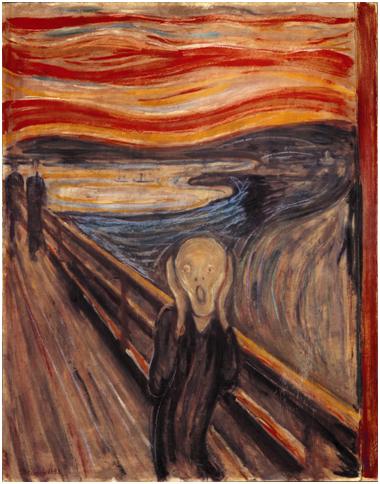
So you think you know Edvard Munch? Think again. That’s the tag-line for the Tate Modern‘s new Munch exhibition, whose premise is that Munch is an under-analysed artist, pigeonholed as a troubled loner and worthy of reassessment. They profess that there were more sides to his personality than just ‘the man who painted The Scream’, and the exhibition seeks to find out what else made him tick through an analysis of the other themes in his work, such as his debilitating eye disease, the theatre and his burgeoning interest in film photography. They implore us to see past the “angst-ridden and brooding Nordic artist who painted scenes of isolation and trauma”, but do people really want to strip off the interesting layers to reveal the normal, everyday Eddie underneath?


Within the art community, it is a dream come true to find another piece of the missing puzzle, to “discover” the man behind the artist and to know exactly what his motives and inspirations were for every piece or artistic period in his life. However, representing the “whole picture” detracts from what made the artist interesting or unique in the first place, or even what makes the paintings so breathtaking. It is scientifically proven* that the longer you spend with a partner, the less interesting they become; in this way, the more you know about the banal aspects of an artist’s life, the less legendary they are. Stick to what makes Munch alluring – a tortured, unloved soul who expresses himself through his harrowing, yet awe-inspiring paintings.


Edvard Munch, The Scream, 1893.
Tempera and crayon on cardboard, 91 x 73,5 cm.
Nasjonalmuseet, Oslo.


It is more than agreeable to believe that Munch painted his masterpieces in an oxymoronic frenzy of despair – catharsis for his traumatic youth. But this new wave of “understanding” of every aspect of Munch’s life has led to an interpretation that Munch was well aware of the techniques and visual effects that he employed to such devastating effect, and that it was in fact the commercial viability of reproducing a popular painting that drove Munch to rework his favoured themes time and again. If this is the case, then Munch knew how to play us like a fiddle.


Have these people learned nothing from Munch? Angst sells, big time, and if the Tate wants to increase its footfall, it too should sell out and give the people what they want – a slice of the despondent Munch we think we know. I’ve heard that The Scream is supposed to be a pretty good painting...


Edvard Munch: The Modern Eye is showing at the Tate Modern from 28 June – 14 October 2012. Or, to view some of Munch’s popular works (including The Scream), why not try this Munch art e-book?


*it is not really scientifically proven.

Tuesday, July 24, 2012

Klimt, to love him, or leave him alone

Don’t get me wrong, Gustav Klimt was inherently remarkable at all of his accomplishments and I am fond of his work as well as those he influenced (even if they were on the brink of lunacy, Egon Schiele). However, to be quite honest, I’d never heard of him until approximately seventeen months ago – his impact on art history itself was miniscule in comparison with more notable greats. But suddenly he was all I read about and pieces of his art were unexpectedly in the strangest places. In celebration of his 150th birthday (this past Saturday, to be exact), museums the world over are head-over-feet presenting his works to the public. Who is this man and why can’t I get away from him?

Not the first, and certainly not the last, truly erotic painter, I often find myself entranced by his pieces. The bright, glittery gold and patterns that would normally do in my neutral and solid coloured brain are unforgettable. Nevertheless, I find it difficult to separate the artist in the smock/robe/dress/thing from the philanderer (he had fourteen children, two also named Gustav, by different women!) who seems to have been in love with his muse. That he could be so lucky for her to love him back! Did she?


Gustav Klimt, The Kiss, 1907-1908.
Oil, silver, and gold on canvas, 180 x 180 cm.
Österreichische Galerie Belvedere, Vienna.


Gustav Klimt, Portrait of Emilie Flöge, 1902.
Oil on canvas, 181 x 84 cm.
Historisches Museum, Vienna.


What woman wouldn’t love a man that painted beautiful, timeless portraits of her? That referred to her as his treasure and life? The fact of the matter is that unless science finds some way to bring people back from the dead, not that I think Emilie Flöge and Gustav Klimt would be first on the list, her secret is dead and buried. I hope I have enough wherewithal to destroy all of my love letters before I die – it seems she’s certainly more interesting to talk about because of it, rather than women whose names I can’t pull from the recesses of my brain that wrote for pages and days of their undying love for their own philanderers. Thank you for being a role model for young women everywhere, Emilie; I hope you were happy.

If celebrating birthdays of long-dead people is something you’re in to, go to the Neue Galerie before 27 August to see Gustav Klimt: 150th Anniversary, they are pulling out all of the stops – cakes AND cufflinks! But if you’re more like me and find celebrating the birth of a dead person morbid and disconcerting, enjoy his work in the privacy of your own home with these print and ebook collections: Klimt and Gustav Klimt. (I won’t judge you too harshly if you toast to him, I promise.)

-Le Lorrain Andrews

Monday, July 23, 2012

Doodling with Picasso

The British Museum has managed to wheedle the donation of all one-hundred of Picasso’s etchings which make up the Vollard Suite – no, not the name of a room in a curiously themed hotel, but a massive series of prints created in exchange for a couple of paintings, including two by Cézanne and Renoir.

The critics are clambering all over each other to fawn, simper and gush about the prints and to offer their unsolicited opinions about what the lines and shading could possibly mean, squabbling like children over who can kiss the most arse. I agree that the series does reveal the inner workings of the mind of the artist during a transitional period, but only insofar as my absent-minded phone-doodling offers an insight into my thoughts at that particular moment in time. Ok, so a picture of a stick man and a flower might not be quite as impressive as a Minotaur with breasts, but doodles was what they were, no more, no less.


By Pablo Picasso, aged 43. He drew this horse whilst nattering on the phone. FACT.
Little Horse, 1924(?). Indian ink on paper, 21 x 27.2 cm, The State Hermitage Museum, St Petersburg.


Trading a couple of paintings by known masters for prints by a living artist was a bit of a gamble, but the trick certainly paid off. Well, not for poor old Ambroise Vollard, who died the same year the prints were completed, but a few generations and changes of hand later, and the set is now worth a staggering £900,000. The fools! Picasso’s status as an excellent artist is well-deserved, but just because he is a good artist does not mean that all his art is good art. Once the buzz from this discovery evaporates, I wonder whether they will realise that they’ve been had.

In case the British Museum is interested, I have a few prints for sale, entitled “Tree”, “Swirly Pattern” and “To Do List”. Each one costs £4,500, a bargain at half the price of a Picasso print!

If, contrary to my warning, you want to see these scribblings, the British Museum is holding this exhibition for free until 2 September 2012. If, however, you’d rather see some of Picasso’s real artwork, why not get this Picasso art book, instead.

Friday, July 20, 2012

Leonardo da Vinci: Jack of Everything

I could make another reference to the Teenage Mutant Ninja Turtles and discuss how, both Leonardo the man and the turtle are the eldest, wisest, and most level-headed of their pairings; however, part of that would be false (Donatello [the sculptor] was older by 66 years) and I’d have no way of proving the rest.

Jack of all trades, master of… all trades. Leonardo da Vinci was a painter, sculptor, architect, musician, scientist, mathematician, engineer, inventor, anatomist, geologist, cartographer, botanist, and writer. His friends described him to have extraordinary powers of invention, incredible strength and generosity, boundless grace, an infinite mind, a majestic spirit, and in addition to all of that, he was quite the looker. In his time, a person of such vast skill and personality was considered to be a polymath and amassed many friends. In our time, Da Vinci would likely be thought a gross over-achieving, suck-up nerd and I doubt anyone would go near him.

Leonardo of all trades probably would have been a better turn of phrase, though, not that he needs any more credit.

Lesser known for his ground-breaking understanding of the human body, Da Vinci found interest in dissecting not only human corpses, but also cows, birds, monkeys, bears, frogs, and horses. Over the years Da Vinci found himself particularly apt at recognising illness as well as a being’s emotions – rage being a specialty.


Leonardo da Vinci, Recto: The superficial anatomy of the shoulder and neck. Verso: The muscles of the shoulder, c. 1510-1511.
Pen and ink with wash over black chalk, 29.2 x 19.8 cm.
The Royal Collection.


Leonardo da Vinci, The cardiovascular system and principal organs of a woman, c. 1509-1510.
Black and red chalk, ink, yellow wash, finely pricked through, 46.7 x 33.2 cm.
The Royal Collection.


Pop over to The Queen's Gallery in Buckingham Palace for a crash course on anatomy at the Leonardo da Vinci: Anatomist exhibition. Realise that Da Vinci is much more than the human body? Bring him home with you in either print or digital form: Leonardo da Vinci: Artist, Thinker, Man of Science or Leonardo da Vinci.

-Le Lorrain Andrews

Friday, June 29, 2012

Turner, Monet, Twombly: An Unlikely Trio

1700s, 1800s, 1900s. British, French, American. Romanticism, Impressionism, Symbolism. Looking at these stats, one might wonder what J.M.W. Turner, Claude Monet, and Cy Twombly have in common. Frankly, I’m still trying to work it out for myself.

Through the bulk of each of these artists’ careers, it is quite clear that their works have very little to absolutely nothing in common, causing one to wonder how on earth they’ve been grouped together in the first place. However, if you focus on the last twenty or so odd years of each other their lives, I suppose it is possible to see that Turner’s work slowly morphed into Impressionism, whether he intended it that way or not. While Twombly’s works, especially Blooming, delve into Impressionism with a focus on nature, clearly Monet’s forte.

Take these two paintings for example. I suppose one could, with their eyes crossed and squinting, relate Turner’s Rio San Luca to Monet’s San Giorgio (below).


J.M.W. Turner, The Rio San Luca alongside the Palazzo Grimani, with the Church of San Luca, c. 1840.
Gouache, pencil and watercolour on paper, 19.1 x 28.1 cm.
The Tate Gallery, London.


Claude Monet, San Giorgio Maggiore, 1908.
Oil on canvas, 59.2 x 81.2 cm.
National Museum Wales, Cardiff.


And maybe, one could close their left eye while squinting with the right and see the similarities Twombly has to offer, as in his Seasons collection:


Cy Twombly, Quattro Stagioni: Inverno, 1993-1994.
Acrylic, oil, and pencil on canvas, 322.9 x 230 cm.
The Tate Gallery, London.


If you ask me, Twombly should consider himself quite lucky to be grouped with such influential artists, while Turner and Monet should be questioning how this came to be and perhaps looking to sue on the grounds of libel, slander, and defamation. What do you think? Am I the crazy one?

Compare and contrast the works of these prolific artists at Tate Liverpool’s exhibition: Turner Monet Twombly: Later Paintings, on until 28 October 2012. Also, admire the works of Monet and Turner at home with these beautifully illustrated books on their lives and works Turner and Monet, both available in print and ebook format.

-Le Lorrain Andrews

Tuesday, June 26, 2012

Sistine Madonna, one of the oldest, but still among the most beautiful, women in the world

Raphael, everybody’s favourite Teenage Mutant Ninja Turtle.* His namesake, Italian Renaissance painter, Raphael is also a favourite of his period; he continues to be admired and sought after the world over.

Among his (the painter, of course) most famous works, The Parnassus (1511) and The Miraculous Draught of Fishes (1515), is the Sistine Madonna (below). This work, both simple and beautiful, still raises a lot of questions. Why is Mary’s face already one of concern, much like her general disposition when standing next to Christ on the Crucifix? What’s the deal with the ghostly images in the background – are they souls or cherubs? To whom is Saint Sixtus referring with his pointed finger? Is it the same person by whom Baby Jesus and Mary are entranced? And, most importantly, is Rafael turning over in his Pantheon grave at the idea of the two wistful cherubs, probably the least considered at the time of painting, becoming such a stylised and kitsch image of the 19th century and thereafter?


Raphael, Sistine Madonna, 1512–1513.
Oil on canvas, 269.5 x 201 cm.
Gemäldegalerie Alte Meister, Staatliche Kunstsammlungen, Dresden.


I certainly cannot answer any of these questions. However, I can imagine the splendour and awe that come with standing before Mary’s everlasting beauty and eternal posse. Who will meet me in Dresden?

See the Sistine Madonna and her iconic cherubs for yourself at the Gemäldegalerie Alte Meister exhibition of The Sistine Madonna: Raphael’s iconic painting turns 500, on until 26 August 2012. Also, cherish these images in print or on your e-reader with this Raphael ebook.

*Based on a poll of five people.

Thursday, June 21, 2012

Masters of Disorder: the Shamans or the French?

MASTERS OF DISORDER, the forces at work in the world around us (especially my bedroom), unseen and unheard by all except those few who can divine their want and will. These are the ‘shamans’, or other spiritual leaders, who mediate between the real and spirit worlds, trying to make sense of the ‘disorder’ around us, mystically communicating with the ethereal and “negotiating with the forces of chaos”. The musée du quai Branly has put on an impressive multisensory display of these religious men from a number of tribes around the world that are still in existence today, with many anthropological ‘finds’ (or plunders) accompanied with work by current artists.

It is a welcome opportunity to celebrate what remains of these cultures’ diverse religious and spiritual beliefs, although it is a shame to see that there doesn’t seem to be any acknowledgement of France’s historical involvement in their previous colonisation of these societies. These ‘colonisation deniers’ would like to forget about France’s centuries-long ‘civilising mission’, notably in Africa, whereby “Africans who adopted French culture, including fluent use of the French language and conversion to Christianity,” were rewarded for their efforts with French citizenship and suffrage. Whilst this carrot-not-stick method was preferable to torture, slavery, murder and atrocities, it was still a dark chapter in the history of France, which still overshadows the country and its international relations today.


I’m not asking for an exhibition dedicated to the exploitation of Africa, I just believe that it is hypocritical for a country to celebrate the longevity of belief systems that it was initially instrumental in disrupting, without acknowledgement or apology for the fact.

If I were to choose a subheading to compliment the exhibition title ‘Masters of Disorder’, ‘France’s direct rule in Africa’ would be a good contender.

Leave your Western ideas of spirituality to one side and explore the world of shamanism at the Musée du Quai Branly’s exhibition Les Maîtres du désordre, from 11 April to 29 July 2012, or read about pre‑colonial African Art with this beautifully illustrated ebook.

Monday, June 18, 2012

War and art...

War, what is it good for? An age old question to which I can say: certainly not preserving art or cultural artefacts, nor fostering an atmosphere which might encourage visitors despite the destruction and neglect of surrounding areas caused by war.

After developing an affinity for the images of mosques, madrasahs, and minarets of Central Asia, I find myself torn at the idea of crossing war paths to follow cultural trails.

Consider, for example, the seventh-century crisis in which Constantinople (now Istanbul) already faced with natural disasters and civil wars, as it struggled with religious and political strife. The Ottoman’s further decimated the already under-populated and decimated city in the 1300s, from which only a few items survived and are still available for view. The rest of the Byzantine works were destroyed, stolen, damaged, or simply “lost”.

A vast majority of Byzantine art was almost entirely concerned with religious expression which went on to have a significant impact on the art of the Italian Renaissance. What little art was left found itself in Russia, Serbia, and Greece. Featured below is a piece which remained in Constantinople/Istanbul which serves as a lasting example of the surviving art of Byzantium.


Christ Pantocrator (detail), 1280.
Deisis mosaic.
Hagia Sophia, Istanbul.


I’m pretty sure photos, paintings, and carvings will never do the wonder and beauty of what Byzantium once was, but can see some of what’s left for yourself at The Metropolitan Museum of Art’s  Byzantium and Islam: Age of Transition exhibition through 18 July 2012. Furthermore, bring these images home in the form of this finely illustrated Byzantine Art ebook (also available in printed format).
-Le Lorrain Andrews