Showing posts with label Raphael. Show all posts

Monday, July 22, 2013

Why the Soul of Surrealism is in India

Lee Krasner“Nude Study from Life”, 1938.
©2013 The Pollock-Krasner Foundation/ Artists Right Society (ARS), New York.
The Menil Collection, Houston, gift of William J. Hill, in honour of Christopher de Menil.
Courtesy of The Menil Collection, Houston.
If all the world’s a stage, and all the men and women merely players, then where do the Surrealists sit?
 According to my imagined global map of where art movements should be located, the Impressionists are based in the South of France, the Blaue Reiter in Germany, the Nabis in Stockholm, Cubism in Iceland, the Old Masters (da Vinci, Raphael, Michelangelo, etc.) in Italy, Aestheticism in Decorative Arts in Shanghai, Digital Art in Oslo, and Lyrical Abstraction in Tokyo.

Of course, this is entirely subjective, but I think that certain countries, or cities, really do go hand in hand with the style or ideals that various art movements represent.

 In my opinion, Surrealism would be well represented by some small artistic or spiritual commune in India. The theory of Surrealist Automatic Drawing alone represents this to near perfection. The idea is that the drawing comes from allowing your hand to move at random across the page, leaving the image free of logical or rational thought processes, and allowing chance to play a large part in the final result. Another part of the thinking behind this is that, without the logical part of your brain being used, the subconscious also affects the final result – thereby allowing a hidden part of the psyche to be revealed.

“The real functioning of thought”: André Breton (the founder of Surrealism) pinpointed the expression of this as the ultimate aim of Surrealism. So, yes, in my eyes, a spiritual commune in India is the perfect base location for all budding Surrealists. Namaste.

Left:
Ajanta Caves.
Maharashtra, before 2nd century BCE.
India.
Right:
Harmandir Sahib (Golden Temple).
Amritsar, Punjab, 1585-1604.
India.


If you are interested in Surrealism, but a journey to India seems a little far (or far-fetched), the Menil Collection, Houston, is the perfect alternative. Currently hosting the exhibition Late Surrealism, you have until August 25th to get to grips with your subconscious, and those of the artists represented. If you’d prefer to do so in the privacy of your own home, grab a copy of Nathalia Brodskaïa’s Surrealism!

- Fiona Torsch


Thursday, June 13, 2013

Erase the line between Genius and Insanity!

Being labelled a genius puts one precariously close to being pigeonholed as insane. Where insanity is recognised as the repetition of the same action over and over, is genius not finally achieving some far-fetched goal, whether it is in science, maths, or art? History is littered with larger than life talents that we still learn about in our studies and discuss with our peers: Einstein, Michelangelo, Da Vinci, etc.

Sandro Botticelli, Study for The Adoration of the Child, c. 1495. Pen shaded with brown, white heightening, and pink wash, 16.1 x 25.8 cm. Galleria degli Uffizi, Florence.
Sandro Botticelli, Study for The Adoration of the Child, c. 1495.
Pen shaded with brown, white heightening, and pink wash, 16.1 x 25.8 cm.
Galleria degli Uffizi, Florence.


Artists made sketches and drafts of the way the human body works, whether in physical labour or dancing, to better portray the human condition in their paintings. Michelangelo and Degas are not only famous for the Sistine Chapel and Impressionism respectively, but also for the way their images came to life – the strength and beauty of their depictions is only so because of their relentless repetition of drawing the same things over and over again – genius or insane?

Thursday, October 11, 2012

Women of the Pre-Raphaelite Movement: Models, Muses, Lovers, Artists

When you think of “Pre-Raphaelite”, what comes to mind? For me, it is male painters, female subjects, a lot of nature, and vivid colours. And for 95% percent of paintings produced by this movement, this is the reality.

The key members of the group (Hunt, Millais, the two Rossettis, Collinson, Stephens, and Woolner) were all men. Together, they created a secret group called the Pre-Raphaelite Brotherhood. Like just about every other artistic movement, the Brotherhood wanted reform. They rejected the academic styles of Raphael and artists after him, finding them idealised and corrupted. The Brotherhood sought a return to the Pre-Raphael Italian style with its vivid colours and imitation of nature.


Sir John Everett Millais, Ophelia, 1851-1852.
Oil on canvas, 76.2 cm × 111.8 cm.
Tate Britain, London.


The Pre-Raphaelites insisted on painting nature from direct observation to ensure it was depicted with accuracy and detail. Millais even stood outside for four months painting the background of one of the most well-known paintings of the movement, Ophelia (above). After he painted the landscape, he had the model for Ophelia lie in a full bathtub in his studio. But who was this model whose face is now so well-known? Her name was Elizabeth Siddal, and she eventually became a Pre-Raphaelite artist as well, which brings us to the exceptions to the 95% rule I mentioned earlier: the female artists who successfully joined the “brotherhood.”

Elizabeth Siddal was one of several model-turned-artists of the Pre-Raphaelite movement. She was a model for almost all of the members of the Brotherhood, and was the primary subject of Rossetti (who was said to have painted Siddal thousands of times). It’s no surprise that Rossetti and Siddal became lovers and eventually married. Rossetti taught Siddal to paint; she caught on quickly and developed her own unique style. Her self-portraits (see below) are interesting because one can compare how she perceived herself as opposed to how she was perceived by the artists she modelled for. Her other paintings (such as The Ladies’ Lament, below) are characteristic of the Pre-Raphaelite movement, with their focus on nature, vivid colours, and realistic subjects.


Elizabeth Siddal, Self Portrait, 1853-54
Oil on canvas, 22.9 cm circle.
Private collection.


Elizabeth Siddal, The Ladies' Lament, 1856.
Watercolour on paper, 241 x 229 mm.
Tate Britain, London.


Siddal was not the only female Pre-Raphaelite artist. Another notable woman from the movement was Rosa Brett, who was taught to paint by her brother, John Brett, and focused on painting landscapes.  In fact, there are at least twenty others. Several of them, including the celebrated Jane Burden Morris, were also models-turned-lovers-turned-artists like Siddal.

Although these 19th century women did not have access to their own formal art education, they found other ways to learn. Luckily for them, the Brotherhood was actually quite forward-thinking in their attitude towards female painters, who they welcomed into their circle. Despite the implied gender in the name, the Pre-Raphaelite Brotherhood was a movement that enabled women to pursue their passions and do more than just pose for paintings. Women were finally beginning to establish themselves in the artistic world.

If you are in London before January 13, 2013, make sure to check out the exhibition on the Pre-Raphaelites at the Tate Britain. You may be distracted by the amazing paintings by the Brotherhood, but keep your eye out for the 5%—the ones done by the women. If you can’t make it to the exhibition or just want to learn more about this movement, check out our ebook.

Wednesday, August 15, 2012

Engel in der Kunst

Große, geflügelte Wesen mit Heiligenschein, heller Haut in weißen, wallenden Kleidern, Putten oder auch kleine Nackedeis mit rosigen Wangen und den typischen blonden Engelslöckchen – diese Engelsbilder habensich in unseren Köpfen fest verankert. Heutzutage gibt es kaum einen Haushalt ohne Engel: Als kleine Statuen sitzen sie bevorzugt auf den Fensterbänken oder in Vitrinen der Schlaf- und Kinderzimmer, sie baumeln als Schutzengel am Schlüsselanhänger, kleben als Sticker auf Fensterscheiben, Tapeten und Schränken oder bevölkern Keksdosen, Kissen und Bettdecken.

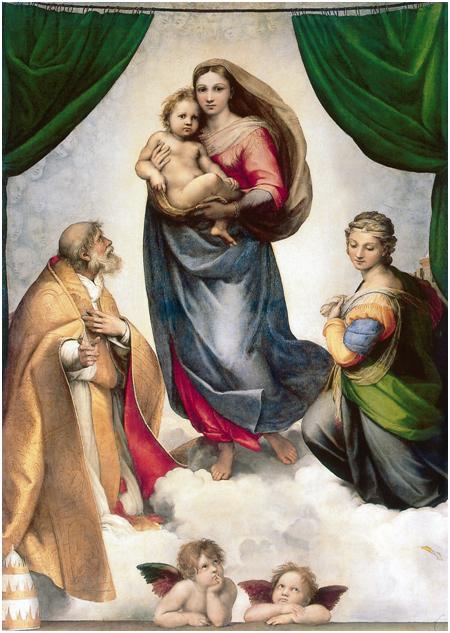
Während die zwei verträumt schauenden Engel des italienischen Renaissancekünstlers Raphael (1483-1520) sich weltweit auf unzähligen Kunstdrucken, Dekoartikeln und Haushaltswaren aller Art befinden, ist vielen ihrer Eigentümer gar nicht bekannt, dass es sich bei dem Motiv lediglich um einen winzigen Ausschnitt eines der berühmtesten Gemälde der Kunstgeschichte handelt: Der eigentliche Hauptakteur, nach dem das Gemälde auch benannt ist, ist die Sixtinische Madonna (Dresden, Gemäldegalerie Alte Meister).


Raphael, Die Sixtinische Madonna, um 1512.
Öl auf Leinwand, 269,5 x 201 cm. Gemäldegalerie Alte Meister, Dresden.


Auf dem um 1512 ursprünglich für den Hochaltar der Klosterkirche San Sisto in Piacenza geschaffenen Gemälde befindet sich die Madonna mit dem Kind auf dem Arm vor einem hellblauen Himmel auf einer wattebauschartigen Wolke stehend als großformatige, die Bildmittelachse einnehmende Figur im Zentrumder Darstellung. Mit auf der Wolke, etwas tiefer positioniert, stehen zu ihrer Rechten Papst Sixtus II. und zu ihrer Linken die Heilige Barbara.

Die Dreieckskomposition nimmt nahezu die gesamte Bildfläche ein. Der grüne, auf beiden Seiten zurückgeraffte Vorhang und die am unteren Bildrand aufgestützten Engel lassen das Dargestellte wie ein Bühnenbild erscheinen. Während die beiden kleinen, nackten Putten, die nicht einmal ein Zehntel des Bildes einnehmen, auf dem Gemälde neben den Hauptakteuren nur als Statisten auftauchen, sind sie heutzutage wahre Verkaufsschlager und ein auch von der Werbeindustrie gern als Symbolträger verwendetes Motiv.

Unsere Vorstellung von Engeln wurde zum größten Teil durch die christliche Kunst geprägt. Engel tauchen an vielen Stellen in der Bibel auf und sind ein beliebtes und oft dargestelltes Motiv der bildenden Kunst. Im Laufe der Jahrhunderte haben Künstler sie immer wieder abgebildet und mit verschiedenen Attributen ausgestattet: als himmlische Wächter (Cherubim), Engel der Anbetung (Seraphim) oder Himmelsboten (Erzengel). Die Isolation der Raphael-Engel und deren Entwicklung zu einem eigenständigen Motiv der Alltagskultur zeigt jedoch, dass die große Faszination für Engel offenbar unabhängig vom religiösen Kontext besteht.

Die Ausstellung Angels in Art im The Israel Museum in Jerusalem bietet noch bis zum 21. Dezember 2012 eine gute Gelegenheit, einen Überblick über die religiöse Engelsthematik in der Kunst zu erhalten. In der Ausstellung werden vor allem Gemälde mit christlicher und jüdischer, aber auch mit islamischer Motivik präsentiert. Ausgestellt sind unter anderem Werke der barocken Maler Pieter Lastman (um 1583-1633), Jacob Jordaens (1593-1678) und Pedro Orrente (1580-1645), des französischen Malers, Grafikers und Bibel-Illustrators Gustave Doré (1832-1883) sowie der israelitischen Künstler Ephraim Maurycy Lilien (1874-1925), Arie Aroch (1908-1974) und Uri Radovan (*1978).

Wenn Sie mehr über Engel in der Kunst erfahren möchten, empfehlen wir Ihnen das im Verlag Parkstone-International erschienene E-Book Angels, in dem Sie mit vielenBildbeispielen die historische Entwicklung der Engelsdarstellungen durch alle Epochen hindurch verfolgen können.

-C. Schmidt

Thursday, June 28, 2012

Un anniversaire pas comme les autres…

Vous êtes convié à une fête d’anniversaire… Et vous connaissez peut-être celle qui souffle les bougies…

La Madone Sixtine, une des plus célèbres toiles du peintre Raphaël (1483-1520), fête en effet ses 500 ans en 2012 ! Une des plus célèbres et une des plus mystérieuses aussi… Pourquoi les visages de Marie et de Jésus regardent-ils, pleins d’angoisse, en direction du spectateur ? Pourquoi le doigt du saint à droite de Marie est-il pointé vers le public ? Que signifient les visages fantomatiques visibles à l’arrière-plan ? Enfin, pourquoi la scène toute entière ressemble-t-elle autant à un décor de théâtre ?


Raphaël, Madone Sixtine, 1512-1513.
Huile sur toile, 265 cm × 196 cm.
Gemäldegalerie Alte Meister, Dresde.


Mais la question la plus mystérieuse de toutes reste celle-ci : pourquoi les deux anges dans le bas du tableau, qui ne sont qu’un détail, sont-ils devenus si célèbres ?

Si l’on regarde l’ensemble de son œuvre, Raphaël, c’est d’abord la splendeur de la chair (Le Triomphe de Galatée, vers 1512) et l’intensité des regards (Portrait de Bindo Altoviti, vers 1515). Mais Raphaël, c’est surtout le peintre qui sait saisir l’instant… On dirait que le dernier coup de pinceau vient à peine d’être donné. On serait même tenté de croire que les personnages vont se mettre à parler (La Pêche miraculeuse, 1515-1516)…

Profitez de l’exposition The Sistine Madonna: Raphael’s iconic painting turns 500, présentée jusqu 26 avril 2012 à la Gemäldegalerie Alte Meister de Dresde (Allemagne) pour voir enfin en vrai ces deux anges que vous avez si souvent croisés !
En attendant, laissez-vous emporter par le mouvement des très belles reproductions de l’ouvrage Raphaël (version imprimée ou version e-book), qui vous transportera en pleine Renaissance…

Tuesday, June 26, 2012

Sistine Madonna, one of the oldest, but still among the most beautiful, women in the world

Raphael, everybody’s favourite Teenage Mutant Ninja Turtle.* His namesake, Italian Renaissance painter, Raphael is also a favourite of his period; he continues to be admired and sought after the world over.

Among his (the painter, of course) most famous works, The Parnassus (1511) and The Miraculous Draught of Fishes (1515), is the Sistine Madonna (below). This work, both simple and beautiful, still raises a lot of questions. Why is Mary’s face already one of concern, much like her general disposition when standing next to Christ on the Crucifix? What’s the deal with the ghostly images in the background – are they souls or cherubs? To whom is Saint Sixtus referring with his pointed finger? Is it the same person by whom Baby Jesus and Mary are entranced? And, most importantly, is Rafael turning over in his Pantheon grave at the idea of the two wistful cherubs, probably the least considered at the time of painting, becoming such a stylised and kitsch image of the 19th century and thereafter?


Raphael, Sistine Madonna, 1512–1513.
Oil on canvas, 269.5 x 201 cm.
Gemäldegalerie Alte Meister, Staatliche Kunstsammlungen, Dresden.


I certainly cannot answer any of these questions. However, I can imagine the splendour and awe that come with standing before Mary’s everlasting beauty and eternal posse. Who will meet me in Dresden?

See the Sistine Madonna and her iconic cherubs for yourself at the Gemäldegalerie Alte Meister exhibition of The Sistine Madonna: Raphael’s iconic painting turns 500, on until 26 August 2012. Also, cherish these images in print or on your e-reader with this Raphael ebook.

*Based on a poll of five people.