Showing posts with label Angst. Show all posts

Monday, August 13, 2012

Munch, un peintre horrifié ?


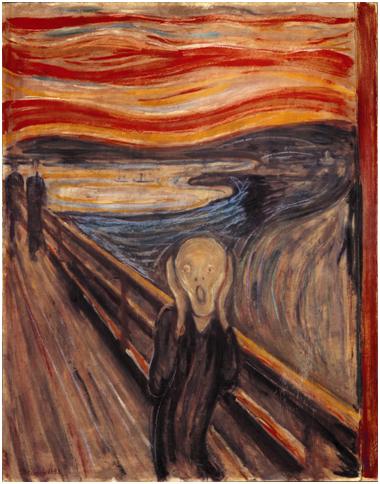
Edvard Munch, Le Cri, 1893.
Tempera et crayon sur carton, 91 x 73,5 cm.
Nasjonalmuseet, Oslo.


Entre 1883 et 1884, l’éruption du volcan indonésien Krakatoa est perçue jusqu’en Europe et enflamme le ciel norvégien. Dix ans plus tard, Edvard Munch s’inspire de ces couleurs flamboyantes pour peindre Le Cri. Un personnage fantomatique se tient le visage et semble hurler, debout au sein d’un paysage dénudé, enflammé à l’horizon par un ardent soleil couchant.

Plusieurs versions de cette peinture sont conservées.

En général, les critiques classent Munch dans la catégorie des peintres touchés par les épreuves de la vie, ce qui doit se refléter dans ses toiles.

L’exposition de la Tate Modern tente d’atténuer ce jugement en montrant comment il a aussi été inspiré par de simples événements du quotidien de la vie des Norvégiens au début du xxe siècle.

Le spectateur a souvent l’impression que les personnages de Munch marchent vers lui ; ce sont des acteurs en plein action. Munch peut être considéré comme l’un des précurseurs des plans du cinéma, sans doute influencé, à son époque, par son goût pour la photographie.

Si son histoire vous intrigue, vous pouvez consulter Munch, en version imprimée et ebook.

Friday, July 27, 2012

Munch ado about nothing

So you think you know Edvard Munch? Think again. That’s the tag-line for the Tate Modern‘s new Munch exhibition, whose premise is that Munch is an under-analysed artist, pigeonholed as a troubled loner and worthy of reassessment. They profess that there were more sides to his personality than just ‘the man who painted The Scream’, and the exhibition seeks to find out what else made him tick through an analysis of the other themes in his work, such as his debilitating eye disease, the theatre and his burgeoning interest in film photography. They implore us to see past the “angst-ridden and brooding Nordic artist who painted scenes of isolation and trauma”, but do people really want to strip off the interesting layers to reveal the normal, everyday Eddie underneath?


Within the art community, it is a dream come true to find another piece of the missing puzzle, to “discover” the man behind the artist and to know exactly what his motives and inspirations were for every piece or artistic period in his life. However, representing the “whole picture” detracts from what made the artist interesting or unique in the first place, or even what makes the paintings so breathtaking. It is scientifically proven* that the longer you spend with a partner, the less interesting they become; in this way, the more you know about the banal aspects of an artist’s life, the less legendary they are. Stick to what makes Munch alluring – a tortured, unloved soul who expresses himself through his harrowing, yet awe-inspiring paintings.


Edvard Munch, The Scream, 1893.
Tempera and crayon on cardboard, 91 x 73,5 cm.
Nasjonalmuseet, Oslo.


It is more than agreeable to believe that Munch painted his masterpieces in an oxymoronic frenzy of despair – catharsis for his traumatic youth. But this new wave of “understanding” of every aspect of Munch’s life has led to an interpretation that Munch was well aware of the techniques and visual effects that he employed to such devastating effect, and that it was in fact the commercial viability of reproducing a popular painting that drove Munch to rework his favoured themes time and again. If this is the case, then Munch knew how to play us like a fiddle.


Have these people learned nothing from Munch? Angst sells, big time, and if the Tate wants to increase its footfall, it too should sell out and give the people what they want – a slice of the despondent Munch we think we know. I’ve heard that The Scream is supposed to be a pretty good painting...


Edvard Munch: The Modern Eye is showing at the Tate Modern from 28 June – 14 October 2012. Or, to view some of Munch’s popular works (including The Scream), why not try this Munch art e-book?


*it is not really scientifically proven.

Monday, July 2, 2012

Liebe und Leidenschaft

Liebe, Angst, Trauer, Freude und Lust sind Gefühle, mit denen wohl jeder schon einmal konfrontiert worden ist. Resultierend aus Emotionen, die wiederum eine Folge aus verschiedenen im Körper ablaufenden chemischen Reaktionen sind, die dann im Gehirn zu einem dieser Gefühle verarbeitet werden und anschließend in der Kontraktion verschiedener, die Gestik und Mimik beeinflussender Muskeln für unsere Umwelt sichtbar werden.

Die Rationalität eines Gefühls und seiner Entstehung erscheint in der Selbsterfahrung jedoch häufig irrational, und so ist es auch für den Menschenkenner nicht immer ein Leichtes, verschiedene Gefühlsregungen seines Gegenüber richtig zu deuten. Das mit oder über jemanden Lachen, kann ähnlich missverstanden werden wie das Weinen vor Freude, Wut oder Trauer.

Während die Deutung der Gestik und Mimik eines Gegenüber mitunter schon schwierig sein kann, sehen wir uns ebenso mit dem Versuch konfrontiert, die Empfindungen einer Mona Lisa, eines Pygmalion oder einer geraubten Europa, gelegentlich fast verzweifelnd, nachzuempfinden.


Dante Gabriel Rossetti, Paolo and Francesca da Rimini, 1867.
Aquarell, Gouache und arabischer Gummi über Bleistift auf zwei Blättern Papier, 43,7 x 36,1 cm.
National Gallery of Victoria, Melbourne.


Selbst der auf den ersten Blick recht unmissverständlich erscheinende Kuss ist nicht nur Ausdruck der Lust, der puren Leidenschaft oder gar der Liebe, er kann ebenso nur freundschaftlicher Natur sein oder verräterisch.

Besonders faszinierend ist das seit Jahrhunderten sichtbare Interesse der Künstler an der Darstellung der menschlichen Empfindungen, in ihrer Schönheit und gesamten Differenziertheit. Die Herausarbeitung von Gestik und Mimik sowie die Einbettung in eine das Gefühl widerspiegelnde Bildatmosphäre mit flirrenden Farben, dunklen Räumen oder abstrakten Formen geben dem Betrachter die Möglichkeit, die Liebe, Wut, Angst und Freude nachzuvollziehen, garantieren aber nicht immer eine ultimative Antwort. So verlangt auch der romantische Kuss häufig nach der Geschichte der Liebenden, um ihn besser verstehen zu können.


Francesco Hayez, Der Kuss, 1859.
Öl auf Leinwand, 110 x 88 cm.
Pinacoteca di Brera, Milan.


Vielleicht ist es aber gerade diese kleine, bis zuletzt offen gehaltene und übrig bleibende Unklarheit über das Gefühl, die die Magie der Darstellungen ausmacht.

Noch bis zum 12. August 2012 können Sie im schwedischen Nationalmuseum in Stockholm in der Ausstellung Passions – Five Centuries of Art and the Emotions Künstler auf ihrer Entdeckungsreise des menschlichen Gefühls begleiten oder sich mit diesem wunderschön illustrierten Buch Love im handlichen Geschenkformat die Liebe zumindest visuell schon einmal nach Hause holen.


Wenn Sie sich mehr für den physischen Aspekt der Liebe und zwischenmenschlichen Beziehung interessieren, sollten Sie unbedingt einen Blick in unsere Bildbände Erotische Kunst, Encyclopædia Erotica und Das erotische Foto werfen.