Showing posts with label jerusalem. Show all posts

Wednesday, August 15, 2012

¿Son los ángeles víctimas de la moda?

Cuando tenía 4 años, murió mi abuela. Mis padres, imagino que en su afán de no traumatizarnos a mis hermanos y a mí, nos dijeron que habían venido unos ángeles a llevársela. Eso habría dejado tranquilo a cualquier niño, ya que estos seres celestiales tienen fama de bondadosos y protectores del ser humano. Y de hecho funcionó con el resto de mi familia, pero yo no soy cualquier niño y me pasé los meses siguientes aterrorizada ante la idea de que un ángel pudiera venir y llevárseme a mí también, o peor aún, a mis padres y hermanos (esta idea me resultaba especialmente horrible en los días de tormenta). Si a esto añadimos que por aquel entonces iba a un colegio de monjas y mi clase estaba muy cerca de la capilla, podéis haceros la idea de que ese año no fue el mejor de mi vida.

Pero dejando fantasías infantiles a un lado, los ángeles han estado representados en el arte desde que el hombre es hombre (o, quizá mejor dicho, desde que dios es dios) y están presentes en las tres religiones del libro. Seguidores de las modas, heredaron sus alas la mitología griega y cambiaron sus vestimentas conforme a los gustos de cada época, desde el uniforme militar del principio (no olvidemos que son el ejército de dios) hasta las túnicas con que todos nosotros solemos imaginarlos.


Edward Burne-Jones, Un ángel tocando el fagot (detalle), c. 1878.
Témpera y pintura dorada sobre papel, 74,9 x 61,2 cm.
The National Museums and Galleries on Merseyside, Liverpool.


Carlo Saraceni, Santa Cecilia y el ángel, c.1610.
Óleo sobre lienzo, 172 x 139 cm.
Palazzo Barberini, Galleria Nazionale d’Arte Antica, Roma.


Estas criaturas divinas han traspasado a todas luces el campo de la religión y ahora las tenemos por todos lados: postales de San Valentín, imanes para la nevera, series anime, canciones, e incluso anuncios de desodorante o de queso crema, por no hablar de la adaptación que la subcultura gótica ha hecho de su imagen, mezclándola con la de sus compañeros caídos para crear un infierno realmente atractivo (si El Bosco levantara la cabeza).

The Israel Museum, Jerusalem hospeda actualmente una exposición sobre estos seres celestiales en la que podrás apreciar las diferentes estéticas según la época y la religión a la que se adscriben; se podrá visitar hasta el 3 de noviembre de este año. Pero si no tienes tiempo, también puedes llevarte a estos bondadosos —o terroríficos—seres a casa en forma de ebook.

Engel in der Kunst

Große, geflügelte Wesen mit Heiligenschein, heller Haut in weißen, wallenden Kleidern, Putten oder auch kleine Nackedeis mit rosigen Wangen und den typischen blonden Engelslöckchen – diese Engelsbilder habensich in unseren Köpfen fest verankert. Heutzutage gibt es kaum einen Haushalt ohne Engel: Als kleine Statuen sitzen sie bevorzugt auf den Fensterbänken oder in Vitrinen der Schlaf- und Kinderzimmer, sie baumeln als Schutzengel am Schlüsselanhänger, kleben als Sticker auf Fensterscheiben, Tapeten und Schränken oder bevölkern Keksdosen, Kissen und Bettdecken.

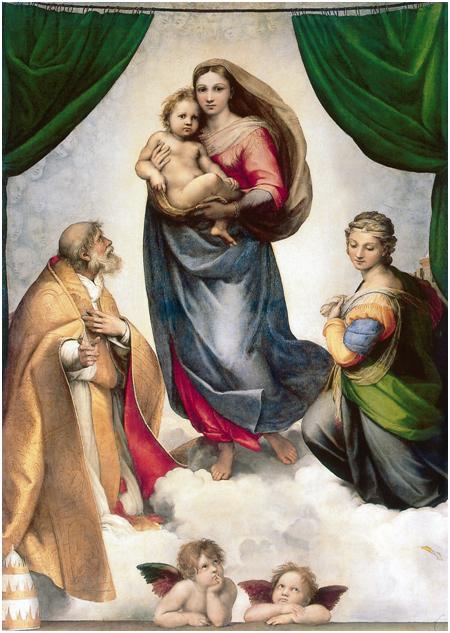
Während die zwei verträumt schauenden Engel des italienischen Renaissancekünstlers Raphael (1483-1520) sich weltweit auf unzähligen Kunstdrucken, Dekoartikeln und Haushaltswaren aller Art befinden, ist vielen ihrer Eigentümer gar nicht bekannt, dass es sich bei dem Motiv lediglich um einen winzigen Ausschnitt eines der berühmtesten Gemälde der Kunstgeschichte handelt: Der eigentliche Hauptakteur, nach dem das Gemälde auch benannt ist, ist die Sixtinische Madonna (Dresden, Gemäldegalerie Alte Meister).


Raphael, Die Sixtinische Madonna, um 1512.
Öl auf Leinwand, 269,5 x 201 cm. Gemäldegalerie Alte Meister, Dresden.


Auf dem um 1512 ursprünglich für den Hochaltar der Klosterkirche San Sisto in Piacenza geschaffenen Gemälde befindet sich die Madonna mit dem Kind auf dem Arm vor einem hellblauen Himmel auf einer wattebauschartigen Wolke stehend als großformatige, die Bildmittelachse einnehmende Figur im Zentrumder Darstellung. Mit auf der Wolke, etwas tiefer positioniert, stehen zu ihrer Rechten Papst Sixtus II. und zu ihrer Linken die Heilige Barbara.

Die Dreieckskomposition nimmt nahezu die gesamte Bildfläche ein. Der grüne, auf beiden Seiten zurückgeraffte Vorhang und die am unteren Bildrand aufgestützten Engel lassen das Dargestellte wie ein Bühnenbild erscheinen. Während die beiden kleinen, nackten Putten, die nicht einmal ein Zehntel des Bildes einnehmen, auf dem Gemälde neben den Hauptakteuren nur als Statisten auftauchen, sind sie heutzutage wahre Verkaufsschlager und ein auch von der Werbeindustrie gern als Symbolträger verwendetes Motiv.

Unsere Vorstellung von Engeln wurde zum größten Teil durch die christliche Kunst geprägt. Engel tauchen an vielen Stellen in der Bibel auf und sind ein beliebtes und oft dargestelltes Motiv der bildenden Kunst. Im Laufe der Jahrhunderte haben Künstler sie immer wieder abgebildet und mit verschiedenen Attributen ausgestattet: als himmlische Wächter (Cherubim), Engel der Anbetung (Seraphim) oder Himmelsboten (Erzengel). Die Isolation der Raphael-Engel und deren Entwicklung zu einem eigenständigen Motiv der Alltagskultur zeigt jedoch, dass die große Faszination für Engel offenbar unabhängig vom religiösen Kontext besteht.

Die Ausstellung Angels in Art im The Israel Museum in Jerusalem bietet noch bis zum 21. Dezember 2012 eine gute Gelegenheit, einen Überblick über die religiöse Engelsthematik in der Kunst zu erhalten. In der Ausstellung werden vor allem Gemälde mit christlicher und jüdischer, aber auch mit islamischer Motivik präsentiert. Ausgestellt sind unter anderem Werke der barocken Maler Pieter Lastman (um 1583-1633), Jacob Jordaens (1593-1678) und Pedro Orrente (1580-1645), des französischen Malers, Grafikers und Bibel-Illustrators Gustave Doré (1832-1883) sowie der israelitischen Künstler Ephraim Maurycy Lilien (1874-1925), Arie Aroch (1908-1974) und Uri Radovan (*1978).

Wenn Sie mehr über Engel in der Kunst erfahren möchten, empfehlen wir Ihnen das im Verlag Parkstone-International erschienene E-Book Angels, in dem Sie mit vielenBildbeispielen die historische Entwicklung der Engelsdarstellungen durch alle Epochen hindurch verfolgen können.

-C. Schmidt

Angels à la mode

Close your eyes and picture an angel. Now open them again so you can read the rest of this blog. What did you imagine? I’m guessing a woman wearing a long floaty white dress, effortlessly hovering in the sky (though mysteriously not beating her wings), with a halo atop her long blonde hair and maybe strumming a harp.

Was I right? It is no coincidence that our imagined angels conform to the same stereotypes. In 2008, 55% of Americans, 67% of Canadians and 38% of Britons professed their belief in the existence of guardian angels, and for many they take the “classical” form (human appearance, exceedingly beautiful and blindingly bright), as this is familiar to us and comforting in times of great need.

Our ideas about angels’ appearances have been shaped over the centuries by their depiction in art. Originally, angels in early Christian art were based on their ancient Mesopotamian and Greek predecessors. Though the Bible never mentioned wings, angels suddenly sprouted a pair in the late 4th century, and have worn them ever since. They started out wearing military-style uniform, with a tunic and breastplate, or in the style of a Byzantine emperor. In the Middle Ages they began to dress like a deacon, in long white robes similar to how we would imagine them today.


Edward Burne-Jones, An Angel Playing a Flageolet (detail), c. 1878.
Tempera and gold paint on paper, 74.9 x 61.2 cm.
The National Museums and Galleries on Merseyside, Liverpool.


Carlo Saraceni, St. Cecilia and the Angel, c. 1610.
Oil on canvas, 172 x 139 cm.
Palazzo Barberini, Galleria Nazionale d’Arte Antica, Rome.


The Renaissance introduced cherubs to us, and in the first half of the 18th century, the angels’ dress became more effeminate and revealing, draping over the body like a badly-fitting bed sheet. Although angels were usually depicted as young men, female angels arrived on the scene.

This was the mainstream fashion for Christian angels, but how we view them can be very subjective and easily swayed by religious, cultural and fashion-related factors. One eccentric example can be found in the late 17th to early 18th centuries in Latin America: the ángel arcabucero, who would dress in the manner of the Spanish aristocracy, wielding a great big gun.

If the fashions through the ages have impacted so greatly on the representation of angels in art, what will angels of the future look like? I would like to think that my great great great great great grandchildren will be comforted by a hipster angel, or a 1970s disco dancing diva angel at their bedsides.

As angels have become disassociated with religion, the belief in them has increased, and references to them are rife in popular culture, from representations in Anime to a Robbie Williams song, and even selling out to front a deodorant marketing campaign.

All of this begs the question – what if the ancient Mesopotamians and Greeks had envisioned the winged messengers of the gods as, for example, winged hippos? Would we be visited on the eve of a loved one’s death by a stampede of bellowing hippopotami? Would Robbie Williams have sung an ode to them? It seems unlikely, but as the artistic representations of angels have impacted on the human psyche to the extent that we share one common vision... who knows what could have been?

The Israel Museum, Jerusalem, currently has an exhibition about these celestial beings called Divine Messengers: Angels in Art, until 3 November this year. You can also read more about angels and their representation in art through the ages in this ebook.